
Sports marketing gives apps a unique way to reach highly engaged audiences, from local stadium crowds to millions of fans watching major events around the world.
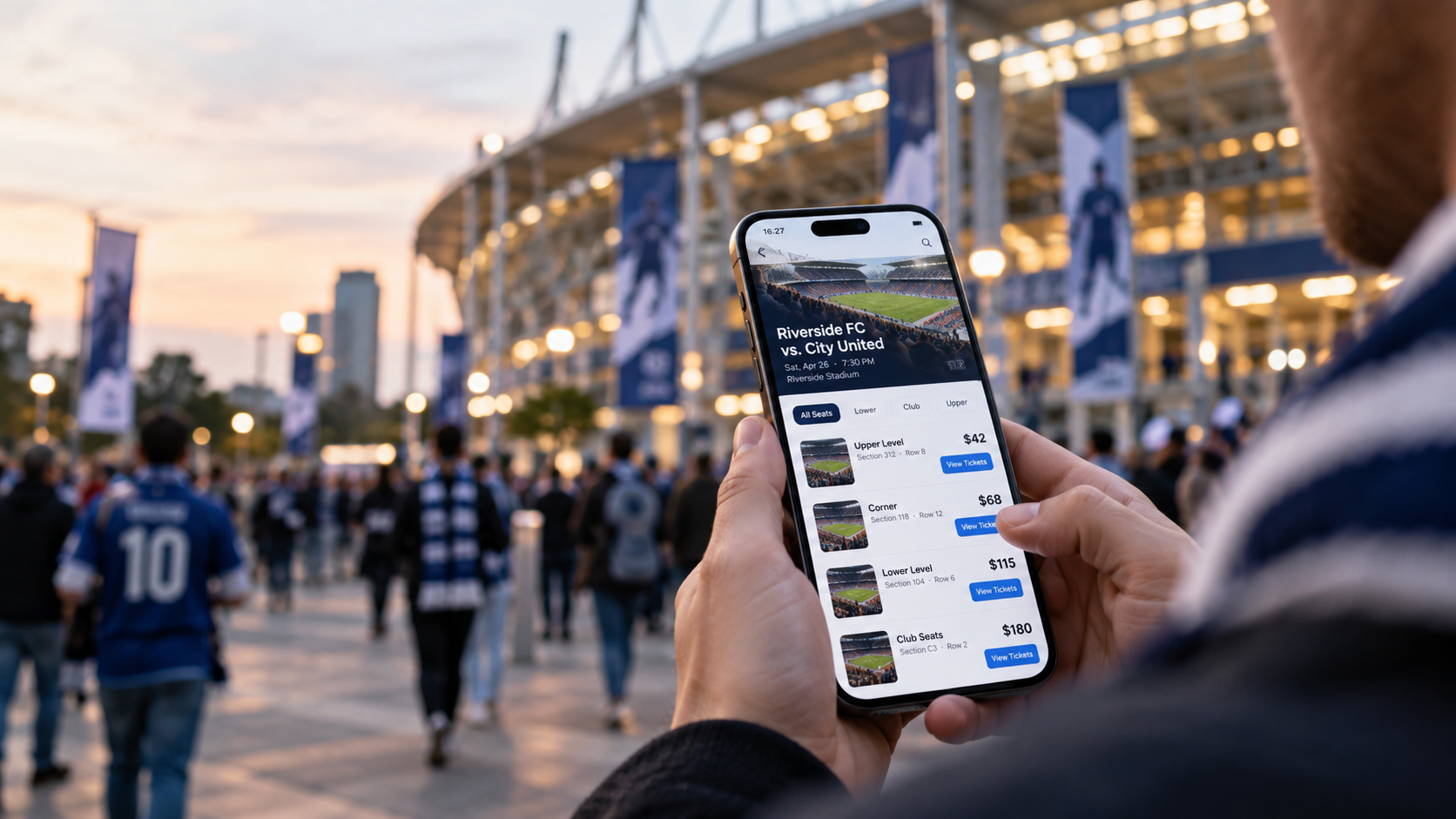
If you have ever been inside a stadium a few minutes before kickoff, tipoff, or first pitch, you already understand why brands want to be part of sports.
Tens of thousands of people are focused on the same event, wearing the same colors, talking about the same players, checking scores, sharing photos, and reacting together. Outside the stadium, millions more may be following the same game through television, streaming, social media, or highlights.
For app marketers, that concentration of attention creates a particularly interesting opportunity because the product they are promoting is often already sitting in the fan’s pocket.
A person can see an activation in a stadium, scan a QR code, search for the brand, visit the App Store, and download the app within minutes. That relatively short path from awareness to action is one of the reasons sports marketing can be especially relevant for mobile apps.
Sports marketing can also operate at very different levels. An app does not need to sponsor a championship or place its logo on a jersey to participate. A smaller company might start with a local watch party, a one-game promotion, or a partnership with an individual athlete. A larger app might work with a team, league, broadcast partner, or international competition.
The opportunity is not simply to put an app logo in front of sports fans. It is to use a moment people already care about to give them a reason to care about the app too.
Before looking at specific tactics, it is worth putting the scale of professional sports into perspective.
Direct comparisons between sports can be difficult because leagues report revenue, attendance, television audiences, and global reach in different ways. Some sports are centered around domestic leagues, while others rely more heavily on international competitions or events.
Still, the numbers make one point very clearly: sports attract a lot of attention, both in person and through media.
American Football: National Football League
The National Football League is one of the clearest examples.
Forbes estimated that its 32 teams generated approximately $21.2 billion in revenue during the 2024 season.
Approximately 18.2 million paid attendees went to regular-season games that year.
The audience becomes dramatically larger around the league’s biggest events. Super Bowl LIX averaged approximately 127.7 million U.S. viewers across television and streaming platforms.
From a marketing perspective, the same sport therefore offers very different levels of reach. A regular-season stadium activation can put a brand in front of tens of thousands of people in one local market, while the league’s championship can create exposure on a national scale.
Basketball: National Basketball Association
Basketball provides a similar range of opportunities.
Forbes estimated approximately $13 billion in league-wide revenue during the 2023–24 National Basketball Association season.
More than 22 million fans attended games during the 2022–23 regular season, according to the league.
Television expands that audience substantially. Approximately 75 million people in the United States watched some portion of the 2025 NBA Finals, while Game 7 averaged 16.6 million viewers.
For an app, this means basketball can support everything from a highly targeted city campaign around one team to a much broader national activation around the league’s most visible moments.
Baseball: Major League Baseball
Major League Baseball generated approximately $12.1 billion in gross revenue during 2024, according to Forbes.
More than 71 million people attended Major League Baseball games during the 2024 regular season, giving brands repeated opportunities to reach fans across a long season.
One of the more interesting examples for international marketers came from the 2024 World Series. Major League Baseball reported an average audience of more than 30 million viewers across North America and Asia, with Japan alone averaging approximately 12.1 million viewers.
This is useful context for apps considering international growth because it shows how a sports property based primarily in one country can still generate substantial attention elsewhere when teams, players, or storylines resonate with another market.
Soccer: Premier League
Soccer takes this international effect even further.
Deloitte reported that Premier League clubs generated approximately £6.8 billion in aggregate revenue during the 2024–25 season.
A record 15.37 million people attended Premier League matches that season, with average attendance above 40,000 per match.
The physical stadium audience represents only part of the opportunity. The Premier League reports that approximately 1.45 billion people watched live Premier League soccer during the 2024–25 season, while its broader global following reaches around 1.9 billion people.
This gives soccer clubs a unique marketing profile. A partnership can feel highly local in Manchester, Liverpool, London, or another home city while still being visible to fans thousands of miles away.
Ice Hockey: National Hockey League
Ice hockey provides another example of concentrated local audiences.
The National Hockey League projected approximately $6.6 billion in revenue for the 2024–25 season, while the same season set a league attendance record with more than 23 million people attending regular-season games.
For locally focused apps, the repeated nature of that attendance can be valuable. A team may play more than 40 regular-season home games, giving brands multiple opportunities to reach people in the same geographic market rather than relying on a single impression.
Motorsport: Formula 1
Formula 1 shows what the same concept can look like globally.
Liberty Media reported approximately $3.87 billion in Formula 1 revenue during 2025. Formula 1 also reported approximately 6.7 million people attending races during the season, alongside a global fanbase estimated at more than 800 million people.
Unlike most domestic leagues, Formula 1 physically moves between countries throughout the year. Each race can therefore function as both a local event and part of a much larger international media platform.
For an app expanding across multiple markets, that combination can be especially interesting.
What all of these numbers actually mean for apps
The point is not that every app should immediately sponsor a professional sports team, nor does a large audience automatically make a sponsorship effective.
The more important point is that sports bring together several things marketers usually have to work hard to find: large audiences, identifiable interests, specific geographic markets, repeated events, recognizable personalities, and strong communities.
Mobile apps have an additional advantage because the device needed to take action is already there. A fan who becomes interested in an app does not necessarily need to remember the brand hours later. They may be able to search for it, visit the App Store, and download it immediately.
A billboard for a car and a billboard for an app ask the audience to do very different things.
Someone interested in the car cannot immediately purchase it from their seat. Someone interested in the app can potentially download it before they even reach their destination.
Deloitte found that 82% of surveyed sports fans use their mobile phones in some way while attending live professional sporting events.
Fans are messaging friends, posting on social media, checking statistics, taking photos, and looking at replays throughout the event. That behavior means an in-stadium promotion does not have to stop at awareness.
A food delivery app, for example, could sponsor a baseball game and offer a post-game discount through a QR code. A fitness app could run a fan challenge and let participants continue tracking results inside the app. A travel app working with a football club could provide away-day travel guides, while a mobility app could promote transportation options to and from the stadium.
The strongest activations usually connect the sport to a reason for using the product. In other words, the goal should not simply be “sports plus logo,” but rather sports plus a relevant use case for the app.
This creates a relatively natural journey from exposure to action. A fan sees the app, something in the promotion catches their interest, and they scan, tap, or search. From there, they reach the App Store, decide whether the product looks relevant, and potentially download it.
That makes the App Store product page an important part of the campaign rather than something that sits separately from it.
Imagine a fitness app spends heavily on a basketball activation.
The arena creative focuses on basketball training, athlete content reinforces the same theme, and the campaign asks fans to “Train Like a Pro.”
Then someone follows the campaign to the App Store and the first screenshots they see focus on yoga, nutrition, and unrelated features.
There may be nothing wrong with that product page in isolation, but the connection created by the sports campaign has weakened.
This is where product-page strategy can support sports marketing.
Apple allows developers to create additional versions of an App Store product page that can contain different screenshots, app previews, and promotional text. These custom product pages also have unique URLs that can be used as destinations for external campaigns.
The same fitness app could therefore send its basketball campaign to a basketball-focused product page that highlights the most relevant features and creative.
The app itself does not need to change. What changes is the context in which it is presented.
For sports campaigns, that can be especially useful because the marketing activity has already told the brand something about the visitor. Someone coming from a Formula 1 activation, a marathon sponsorship, or a football-club campaign has arrived with a particular context, and the product page can continue that conversation instead of starting over with generic messaging.
When people hear “sports sponsorship,” they often think about jersey logos, naming rights, championship commercials, or large league partnerships.
Those opportunities exist, but they represent only one end of the spectrum.
For apps, it is more useful to think about sports marketing across three broad levels: Small, Local, and National. Within each level, brands can use advertising, merchandise, events, and team or athlete activations in different ways.
Small: Use Sports to Test an Audience
A smaller sports campaign can be a practical way to answer an important question before committing to a larger partnership: Do fans of this sport actually respond to our product?
Advertising
An app can advertise around a particular sporting moment without purchasing major official sponsorship rights.
This might include game-day digital advertising, sponsorship of a local sports podcast or newsletter, promotions near a venue, ticket giveaways, or collaborations with sports creators.
For a running app, that could mean testing a campaign around a city marathon. A food app might focus on home-game weekends, while a travel app could target visitors arriving for a major sporting event.
A dedicated product page can also make the campaign easier to evaluate. Because custom product pages have unique URLs, an app can send a sports-specific campaign to a corresponding App Store experience and evaluate metrics such as product page views, downloads, and conversion rate.
This gives smaller campaigns value beyond immediate reach because they can also help the company learn whether a particular sports audience is worth pursuing further.
Merchandise
Merchandise can also work at a small scale.
An app does not need to manufacture thousands of professional jerseys. A limited shirt, scarf, sticker, rally towel, water bottle, or event-exclusive item can still create a physical connection to the campaign.
The objective does not necessarily have to be merchandise revenue. In many cases, the more interesting value is that someone chooses to take the brand home with them.
That creates a different kind of visibility from an advertisement that disappears as soon as the screen changes.
Pop-Up and One-Time Events
For many apps, a small event may be one of the easiest places to start.
A company could organize a pregame event, watch party, fan challenge, meetup, giveaway, or interactive experience around something people already planned to attend.
The app does not have to create the excitement from nothing. The sporting event already provides the reason for people to gather, and the brand’s job is to add something useful, fun, or memorable.
Team and Athlete Activations
Smaller activations can also involve individual athletes rather than an entire team.
A player might participate in an app challenge, a local athlete could host an event, or a creator associated with the sport could demonstrate how the product fits into game day.
This can be a useful way to test the relationship between the product and a sports audience before committing to a larger sponsorship.
Local: Use the Team to Become Part of the Market
The local level becomes especially interesting for apps whose growth depends heavily on geography.
Delivery apps, mobility apps, restaurant apps, ticketing platforms, dating apps, local marketplaces, financial apps, and travel products may all care more about reaching the right city than simply reaching the largest possible audience.
If growth in Chicago matters, repeated exposure to a large group of people in Chicago may be considerably more useful than reaching unrelated consumers across the country.
A local sports team already brings that audience together.
Advertising
In-stadium advertising is one of the most obvious opportunities.
Depending on the partnership, an app might appear on video boards, digital ribbon displays, concourse signage, sponsored replays, team digital channels, local broadcasts, or ticketing communications.
Bumble provides a recognizable example. In 2018, the company entered a partnership with the Los Angeles Clippers that included branding on the team’s jerseys.
A jersey patch is a major sponsorship asset, but the broader idea applies at smaller levels as well. Bumble was connecting its brand with a team and a city where it wanted to be visible.
For an app focused on a particular market, sports can make broad awareness feel surprisingly local.
Merchandise
Merchandise can deepen that relationship by giving fans something tangible connected to both the team and the sponsor.
Spotify’s partnership with FC Barcelona has included limited-edition apparel and merchandise linked to specific artist and football activations.
Most apps will not operate at Spotify’s scale, but the underlying behavior is still relevant. Fans often value objects that help them express their relationship with a team, and a brand that becomes part of something fans genuinely want to wear, collect, or keep can create a more lasting impression than ordinary advertising.
Pop-Up Events
Local partnerships also create opportunities for experiences around the game itself.
Spotify’s FC Barcelona partnership has expanded beyond shirt branding into concerts, fan experiences, merchandise releases, and viewing events.
The same thinking can be adapted on a much smaller scale. A local app could create a pregame fan zone, skills challenge, city guide for visiting supporters, meet-and-greet, or post-game event.
What matters is that the brand gives fans something to participate in rather than simply another logo to look at.
Team Activations
Tinder’s partnership with Manchester City is another useful example.
The partnership extended across Manchester City, Manchester City Women, and New York City FC and included opportunities around matches, events, and fan engagement.
For mobile apps, this type of relationship opens up many possibilities. Players can participate in app content, fans can unlock experiences, users can take part in challenges, and team-related content can live inside the product.
The app starts to become part of the fan experience rather than simply advertising beside it.
National: Use Sports to Accelerate an Already Growing Brand
At the national level, sports marketing usually serves a different purpose.
The company may already have meaningful awareness, and the objective is to make the brand more familiar, reach larger audiences, and create repeated visibility around major cultural moments.
Advertising
TikTok’s UEFA EURO 2020 sponsorship is a good example.
TikTok became a global sponsor of the tournament, with the partnership covering areas such as broadcast sponsorship, digital content, augmented-reality effects, hashtag challenges, and other fan experiences.
DoorDash has taken a similarly broad approach through professional basketball. Its partnerships with the National Basketball Association and Women’s National Basketball Association have included league-level rights, campaigns, athletes, and fan-oriented activations.
At this scale, the value is not one advertisement. The sports property becomes a platform through which the brand can run many different kinds of marketing over time.
Merchandise
At the highest level, app branding can become physically embedded into the sport itself.
Spotify’s logo has appeared on FC Barcelona shirts, while the partnership also includes naming rights for Spotify Camp Nou.
Cash App provides another example through Formula 1. Its name became part of the Visa Cash App RB Formula One Team identity, placing the brand across cars, team assets, broadcasts, social content, and race weekends.
This level of integration will not make sense for most apps, but it demonstrates how sports can evolve from an advertising channel into a much broader brand platform once the product is already established.
Pop-Up and One-Time Events
Major sporting moments also create opportunities outside the stadium.
Around championship games, race weekends, finals, and international tournaments, large numbers of fans travel, gather, post content, look for places to watch, and search for related experiences.
An app can build around that behavior through fan zones, concerts, viewing parties, hospitality, temporary installations, or exclusive content.
The advantage is that the company is entering a moment when people are already looking for things to do and talk about, rather than trying to create that interest from scratch.
Team and Athlete Activations
Athletes can also carry a campaign far beyond the venue.
DoorDash, for example, has incorporated basketball players into campaigns surrounding its league partnerships.
Strava provides another useful example because its product naturally overlaps with the behavior of the sport itself. Its Tour de France relationship works because cycling is not simply something Strava sponsors; cycling is already something many people use Strava to track and share.
That points to an important principle for app marketers: the strongest sports partnership is not necessarily the one with the biggest logo. It is often the one where the product feels like a natural part of the fan or athlete experience.
Launching an app in another country creates a familiar challenge.
The company may already have a strong product, a functioning acquisition strategy, and a localized App Store presence, but very few people in the new market may know the brand.
Building familiarity from zero can take time.
Sports can potentially help with that introduction because a popular club, athlete, or competition already has local recognition, regular media coverage, established fan communities, and a recognizable place in the culture.
That does not mean fans automatically trust every company associated with their favorite team, and a sponsorship does not remove the need for proper localization. What it can do is give an unfamiliar brand a context people already understand.
Spotify and FC Barcelona provide a useful example
When Spotify announced its partnership with FC Barcelona, the company explicitly discussed the club’s global audience and the opportunity to connect the Spotify brand with football fans around the world. It highlighted markets including India, Latin America, and Indonesia as places where Barcelona’s audience overlapped with Spotify’s growth ambitions.
What makes the example particularly relevant for app marketers is that the relationship did not stop with the sponsorship itself.
Spotify also expanded Catalan-language support in the product, connecting part of the partnership back to the actual app experience.
That is an important distinction. The sports partnership can create visibility and provide an introduction, but the product still needs to be relevant to the people who respond to it.
Sports marketing should support localization, not replace it
For an app entering another country, the campaign still needs to consider local language, pricing, culture, relevant features, competitive conditions, onboarding, customer support, and App Store localization.
The sports property can create awareness, but the product page needs to make the app understandable and the product itself needs to deliver on the promise.
A well-connected market-entry journey might therefore begin with a locally or internationally relevant sports property, continue through a market-specific campaign and localized App Store product page, and finish with an app experience that feels appropriate for the audience being acquired.
This is where sports marketing can become more than a media buy. It can become one part of a broader market-entry strategy.
Looking at the scale of professional sports can make it tempting to pursue the largest possible partnership.
But the Super Bowl is not automatically better than a local basketball game, just as the Premier League is not automatically more useful than a city marathon.
The right opportunity depends on what the app is actually trying to accomplish.
If the company is testing whether people in one city want its service, a local activation may be enough. If it is trying to understand whether runners respond to a particular feature, a marathon may be more relevant than a major professional team.
For an established app pursuing national awareness, a league, major athlete, or broadcast partnership may make more sense. And for an app entering another country, the most useful property may be the club, athlete, or competition that already has the strongest connection with the audience it wants to reach.
The better question is therefore not:
“What is the biggest sports sponsorship we can afford?”
It is:
“Where does our product naturally overlap with the way these fans live, watch, travel, exercise, eat, communicate, or spend?”
That is usually where the more interesting opportunities begin.
7. Sports Can Create the Attention. The App Still Has to Finish the Journey.
Sports offer something that is increasingly difficult to recreate through ordinary advertising: large groups of people who are actively paying attention to the same thing.
Fans attend games, watch broadcasts, follow athletes, buy merchandise, travel for events, discuss results, and share those experiences with other people.
Many of them are doing all of this with a phone in their hand.
That makes sports particularly interesting for mobile apps.
A smaller campaign can help an app test a specific audience. A local team can help a brand become more visible in an important city. A national partnership can introduce an established app to millions of people, while an internationally followed sport can potentially provide an unfamiliar brand with a recognizable entry point into another country.
But exposure alone is not the strategy.
The real opportunity comes from connecting that attention to the rest of the user journey. Someone sees the sports activation, becomes interested in the brand, reaches the App Store, understands why the product is relevant, downloads it, and then finds an app experience that delivers on what the campaign promised.
When those pieces connect, sports marketing becomes much more than putting a logo on a scoreboard.
For mobile apps in particular, it can become a practical bridge between brand awareness and actual product discovery, with only a few taps separating the moment someone notices the brand from the moment they become a user.
Sports marketing gives apps a unique way to reach highly engaged audiences, from local stadium crowds to millions of fans watching major events around the world.
ReadApple Ads Tips for Japanese Gaming Companies Expanding to the US and Global Markets
ReadExperience the future of app marketing with V.O.X.
Where visibility meets opportunity.
%20(2).png)

.png)
.png)
.png)